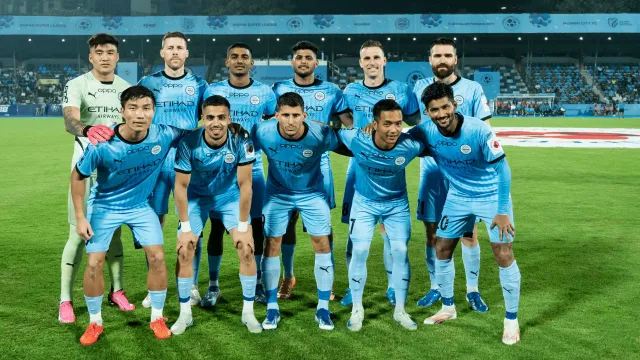

New Delhi Indian football is facing one of its most uncertain periods in recent years as City Football Group (CFG) the global football conglomerate behind Manchester City prepares to exit Mumbai City FC, citing prolonged instability and uncertainty surrounding the Indian Super League (ISL) and the country’s wider football ecosystem.
CFG’s decision comes amid mounting governance, scheduling, and financial challenges that have severely disrupted professional football in India over the past year.

ISL Season in Limbo
The ISL 2025–26 season has been delayed by more than three months, with no confirmed start date, match calendar, or official communication on the league’s operational roadmap. The prolonged uncertainty has left clubs, players, sponsors, and broadcasters in a state of limbo.
Compounding the crisis, both the I-League and I-League 2 remain suspended, effectively bringing India’s domestic football structure to a near standstill.
CFG Withdraws from Mumbai City FC
Amid this chaos, Mumbai City FC has formally informed the All India Football Federation (AIFF) of a significant change in its ownership structure. Once regulatory formalities are completed, CFG will fully withdraw from the club, ending its association with Indian football.
Following CFG’s exit, Mumbai City FC will revert to 100 percent ownership under actor Ranbir Kapoor and businessman Bimal Parekh, who were part of the club’s original ownership group before CFG’s investment.
The timing of CFG’s withdrawal closely mirrors the deepening crisis within Indian football, raising concerns about the league’s credibility and long-term sustainability.
Financial Strain on Clubs and Federation
The instability has placed clubs under severe financial pressure. According to internal federation documents, the AIFF currently holds Rs. 19.89 crore in its bank accounts, yet plans to spend Rs. 50.48 crore between January and May 2026.
Even after factoring in a projected surplus of Rs. 9.44 crore, the federation is expected to face a deficit of Rs. 23.11 crore by May 31, 2026, highlighting the growing financial stress at the governing body level.
Loss of Commercial Revenue
The crisis has been worsened by the expiry of the Master Rights Agreement, which previously served as a major revenue stream for clubs. With no replacement deal in place, teams have struggled to meet operational costs, including player salaries, logistics, and training expenses.
Players and coaching staff remain idle due to the lack of competition, while several foreign coaches and support staff have reportedly expressed frustration, with some reconsidering their future in Indian football.
Investor Confidence Erodes
CFG’s decision to pull out is widely seen as a serious blow to investor confidence, particularly because the group represents one of the most sophisticated and financially stable football organizations in the world.
Analysts warn that if governance and commercial clarity are not restored soon, other ISL clubs may face similar ownership or financial challenges, potentially leading to further exits or downsizing.
Uncertain Road Ahead
With the future of the ISL still unresolved and no clear timeline for the resumption of domestic competitions, Indian football stands at a crossroads. CFG’s withdrawal has raised urgent questions about leadership, financial planning, and the long-term vision for the sport in the country.
Unless swift reforms and transparent communication are implemented, stakeholders fear that the current crisis could have lasting consequences for the development of football in India.